
Understand how a data center project is structured, what its main challenges are, and how BIM contributes to greater control, integration, and efficiency.
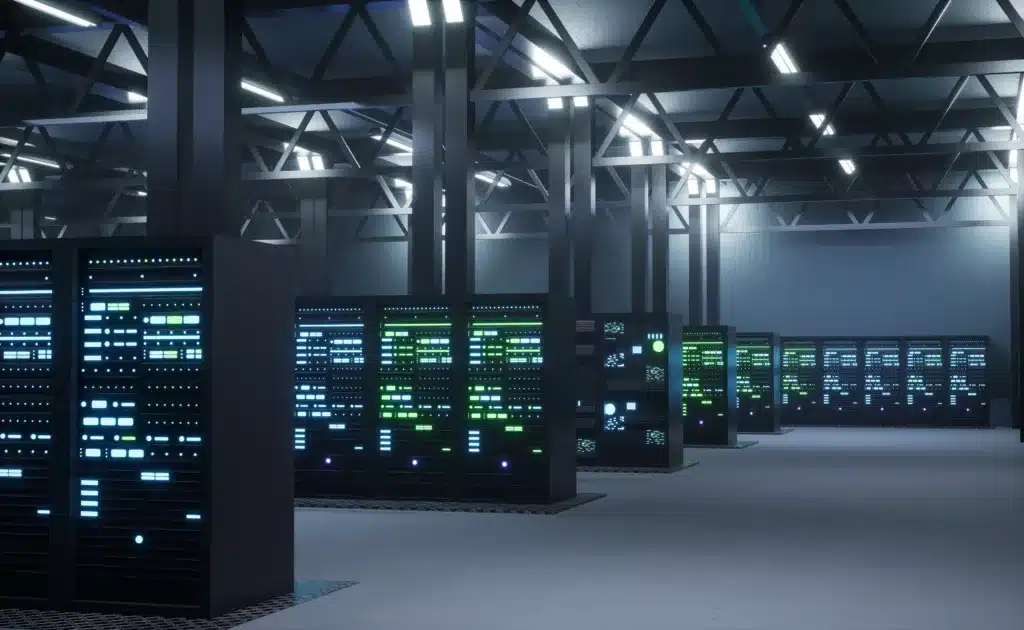
Data center projects They are among the most complex in modern engineering. They require millimeter precision, complete integration between multiple disciplines and, above all, a very high level of operational reliability.
Unlike conventional civil constructions, in a data center The priority is continuity. After all, the system can never stop.
In this article, we will explore how a... data center infrastructure project, the main challenges of the sector and how the BIM (Building Information Modeling) methodology It has become a pillar of efficiency and control.
Read also: How Cadbim structured the BIM management of one of the most complex data centers in Brazil.
What is a data center project?
A data center is a critical infrastructure designed to store, process, and distribute large volumes of data. For this to occur securely, the design must integrate complex systems of:
- Energy and Redundancy: backup and UPS systems;
- Air conditioning (HVAC): Strict temperature and humidity control;
- Connectivity: Structured cabling and low latency;
- Security and Automation: Real-time monitoring and access control.
The complexity lies in the fact that these disciplines cannot be treated in isolation, as they depend on absolute technical coordination.
The 6 essential steps of a data center project.
Although each project has its own particularities, an efficient workflow follows these main phases:
1. Planning and defining requirements
Here, business objectives, load capacity, and the... are defined. redundancy level (Tier I, II, III or IV), which will determine the system's availability.
Here are the established points:
- operational capacity;
- redundancy level (Tier);
- availability requirements;
- business needs.
2. Preliminary studies and design
The design phase involves defining the macro layout, analyzing the existing terrain or building, and selecting the support systems.
3. Detailed designs
Where the project gains technical depth in architecture, structure, electrical, hydraulic and special fire fighting systems.
4. Compatibility and coordination
This is a critical moment to identify interferences between disciplines (e.g., an air duct colliding with a cable tray). It is here that the risk of rework is mitigated.
5. Execution of the work
The construction phase demands rigorous control. Any mistake can have an impact:
- functioning;
- security;
- availability.
Therefore, the quality of the design directly impacts its execution.
6. Commissioning and operation
Before activation, all systems are tested under extreme conditions to validate that cooling and power are functioning as planned.
Key challenges in data center projects
- High technical complexity: The number of systems and the need for integration make the project more demanding;
- Interdependence between disciplines: An adjustment in one system can impact several others;
- Requirement for operational continuity: Data centers cannot fail. This requires redundancy and precision;
- Information management: The volume of data and decisions is high.
The role of BIM in data center projects.
Given such complexity, BIM (Building Information Modeling) has gone from being just a differentiator to becoming the foundation of these projects. In an environment where every centimeter counts, BIM acts as a "digital twin," allowing the entire operation to be simulated before the first stone is laid.
Below, we detail how this methodology solves the specific problems of critical infrastructures:
Integration between disciplines
The biggest challenge for a data center It is the density of facilities. Air conditioning (HVAC) ducts, data cable trays, and fire suppression systems compete for the same space above the ceiling or below the raised floor.
Therefore, BIM accomplishes the Clash Detection (automated conflict detection), Identifying conflicts between disciplines even in the design phase.
This prevents an assembly team from discovering, mid-project, that a cooling duct is blocking the electrical wiring, eliminating delays and wasted materials.
Centralization of information
Data center projects involve dozens of specialists (electrical, civil, telecom, security). If each one works with a different file, the risk of outdated information is enormous.
BIM centralizes all technical data in a Common Data Environment (CDE), ensuring that the IT designer and the electrical engineer make decisions based on the same version of the project.
For the owner, this means complete control over technical specifications and greater agility in approving changes.
Performance and Energy Efficiency (PUE) Simulation
Energy consumption is one of the biggest operational costs of a data center. With BIM, it is possible to perform thermal simulations (CFD) to understand how air circulates between the racks.
This allows for adjusting the design to optimize cooling and improve PUE (Power Usage Effectiveness), making the venture more sustainable and profitable from day one of operation.
Why is BIM crucial in these projects?
In conventional projects, field errors are corrected with simple adjustments. In data centers, a compatibility error can cause millions of dollars in downtime.
Therefore, the ability to predict and control the project through BIM is crucial.
How does Cadbim operate in data center projects?
Cadbim works in the organization and structuring of complex projects, ensuring that BIM technology is applied to generate technical consistency.
Our focus is:
- Standardize engineering processes;
- Structuring information flows between disciplines;
- Ensure that the digital model is a faithful reflection of the execution.
If your company is looking for more control, integration, and efficiency in critical infrastructure, Learn how Cadbim structures high-performance data center projects..